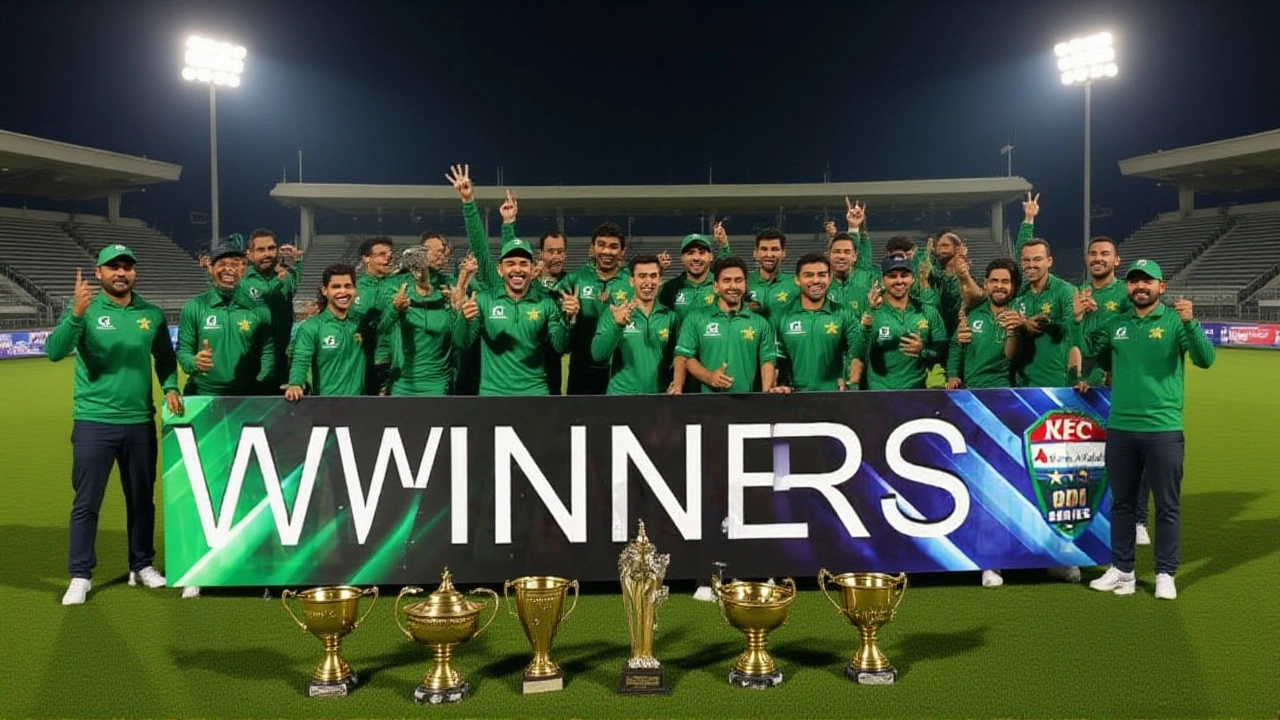
On November 27, 2025, Pakistan wrapped up their Tri-Nation campaign with a clinical 7-wicket win over Sri Lanka at the Rawalpindi Cricket Stadium, sealing their place in the final and eliminating the visitors from tournament contention. Chasing a modest 129, Pakistan reached 131 for 3 in just 15.3 overs, leaving Sri Lanka with no escape route after their earlier collapse against Zimbabwe. The win wasn’t just about runs — it was about momentum, pressure, and the cruel math of net run rate.
What the scoreboard didn’t tell you
Sri Lanka’s 129 for 3 in 14 overs looked competitive — until you remembered they’d been bowled out for 95 against Zimbabwe just days earlier. That innings haunted them. Their net run rate barely improved despite a strong performance against Pakistan, because cricket doesn’t reward good days if you’ve had a terrible one. The Pakistan Cricket Board (PCB) had already confirmed their final spot before this match, but Sri Lanka’s fate hung by a thread: win, and they sneak through. Lose, and Zimbabwe — who’d lost to both teams — would sneak in on run rate. They lost. And Zimbabwe, the underdogs, were suddenly in the final.
It wasn’t just about the numbers. It was about the silence in the Sri Lankan camp after the final ball. The same team that had demolished opponents by nine wickets just two days prior now looked shell-shocked. Their top order, led by Pathum Nissanka’s 8, failed to build. And when the spinners came on — Abrar Ahmed and Mohammad Nawaz — the cracks widened. Pakistan’s bowling attack, often overlooked, was the quiet engine of their dominance.
The architects of victory
Pakistan’s chase was calm, almost clinical. Salman Agha — the uncapped opener — stepped up with a composed 52 off 38 balls, his strike rate of 136.84 turning pressure into momentum. He wasn’t flashy. He was efficient. His partnership with Mohammad Rizwan (41 off 29) steadied the ship after early wickets. When the last over began, Pakistan needed 12. Two boundaries, a single, and the job was done. No drama. No panic.
And then there was the bowling. In the previous ODI series, Naseem Shah and Abrar Ahmed had each taken three wickets to clinch a tense win. Here, in the T20I, their presence loomed large. Though they didn’t dominate this particular innings, their reputation forced Sri Lanka into cautious, error-prone play. The pitch offered turn and variable bounce — conditions Pakistan’s spinners know intimately. Sri Lanka’s middle order, expecting flat decks, got trapped in a web of flight and drift.
The human cost of net run rate
Net run rate is cold. It doesn’t care if you played well. It only cares about the arithmetic. Sri Lanka’s 95 all out against Zimbabwe — a performance that looked like a fluke at the time — became their death sentence. That innings dropped their NRR by 0.92. Even a win against Pakistan couldn’t erase it. Zimbabwe, who’d lost both their matches, finished with a better NRR than Sri Lanka by 0.07. That’s less than a run per over. But in T20s, that’s the difference between a final and a flight home.
“It’s brutal,” said a senior Sri Lankan official, speaking off-record. “We played better cricket than we did in the last three years. But one bad day… it’s like you’re erased.”
Meanwhile, Pakistan celebrated not just a win, but a statement. They’d won all three of their matches at the Rawalpindi Cricket Stadium in this series — two T20Is and an ODI. Their home record in limited-overs cricket since 2023 is now 18 wins in 21 matches. No other team in the world can match that. And they did it without their star all-rounder, Shadab Khan, who was rested.
What’s next? The final and the fallout
Pakistan will face Zimbabwe in the final on November 29 at the same venue. Zimbabwe, who entered the tournament as the weakest side, now have a real shot at their first major T20I title since 2019. Their captain, Sikandar Raza, has been in career-best form, averaging 67 with the bat and picking up 8 wickets in the series. Pakistan, meanwhile, will be without the suspended Mohammad Wasim, who received a one-match ban for a slow over-rate in the previous match.
For Sri Lanka, the tour ends in disappointment. Their selectors now face tough questions: Why did their spinners struggle on home-like pitches? Why did their top order collapse under pressure? And why, after showing promise in the first half of the tournament, did they fold when it mattered?
Behind the scenes: The umpires and the rules
The match was officiated by Pakistani umpires Ahsan Raza and Faisal Khan Aafreedi, with Rashid Riaz as TV umpire and Reon King of West Indies as match referee. No controversial decisions marred the game — a rarity in high-stakes T20Is. The ICC’s decision to use local umpires for regional tournaments is paying off. The crowd, estimated at over 28,000, was loud, proud, and never once questioned the officials.
It was a day that showed how T20 cricket has evolved: less about star power, more about consistency, discipline, and the brutal calculus of run rates. Pakistan didn’t just win a match. They won the narrative.
Frequently Asked Questions
How did Pakistan qualify for the final before this match?
Pakistan had already secured a top-two finish after winning their first two matches against Sri Lanka and Zimbabwe. Their superior net run rate — boosted by a 131/3 win over Sri Lanka and a 98-run victory over Zimbabwe — meant they couldn’t be caught by any other team, regardless of this match’s outcome. Their qualification was mathematically confirmed before the final ball of the previous game.
Why did Zimbabwe advance over Sri Lanka despite losing both matches?
Zimbabwe’s net run rate (NRR) of +0.15 edged out Sri Lanka’s +0.08 because of Sri Lanka’s disastrous 95 all out in 20 overs against Zimbabwe. Even though Sri Lanka beat Zimbabwe later, their massive loss early on dragged down their NRR. In T20 tournaments, one poor innings can erase weeks of good cricket — and that’s exactly what happened.
Who were the standout performers for Pakistan in this series?
Salman Agha emerged as a revelation with 124 runs at 62.00 and a strike rate of 145. Sri Lanka’s spinners couldn’t contain him. Abrar Ahmed took 7 wickets across three matches at an economy of 5.8, while Naseem Shah’s pace and swing in the powerplay gave Pakistan a consistent early advantage. Mohammad Rizwan anchored the batting with 156 runs in the series, including two fifties.
Is this a sign of Pakistan’s return to dominance in home cricket?
Absolutely. Since 2023, Pakistan has won 18 of 21 limited-overs matches at home — the best record in the world. The crowds are back, the pitches favor their spinners and fast bowlers, and the team is playing with confidence. This Tri-Nation series was the clearest signal yet that Pakistan is no longer just hosting events — they’re winning them convincingly.
What does this mean for Sri Lanka’s future in T20 cricket?
Sri Lanka’s top order remains fragile under pressure. Their reliance on Pathum Nissanka and Kusal Mendis is dangerous — if those two fail, the middle order collapses. They need to rebuild their spin attack and develop depth. This loss, while painful, could be the wake-up call they need before the 2026 T20 World Cup. Their next assignment: a bilateral series against Bangladesh, where they’ll need to prove they’re not a one-match wonder.